
More Information
Submitted: October 19, 2026 | Accepted: November 11, 2026 | Published: November 13, 2026
Citation: Garg A, Sharma P, Lamba AS. A Cold Clue to Acute Myeloid Leukemia. Arch Pathol Clin Raes. 2026; 10(1): 1-2. Available from:
https://dx.doi.org/10.29328/journal.apcr.1001046
DOI: 10.29328/journal.apcr.1001046
Copyright License: © 2026 Garg A, et al. This is an open access article distributed under the Creative Commons Attribution License, which permits unrestricted use, distribution, and reproduction in any medium, provided the original work is properly cited.
Keywords: Cold agglutinin syndrome; Acute myeloid leukemia; Autoimmune haemolytic anaemia; Peripheral blood smear; Hepatitis C virus; Red blood cell agglutination

A Cold Clue to Acute Myeloid Leukemia
Aprajita Garg*  , Pooja Sharma and Amtoj Singh Lamba
Chandigarh, India
*Address for Correspondence: Dr. Aprajita Garg, Chandigarh, India, Email: [email protected]
Cold agglutinin disease (CAD) is an uncommon form of autoimmune haemolytic anaemia (AIHA) and accounts for 15-25% of cases of AIHA. It may be known as cold agglutinin disease when arising as a primary disorder or as cold agglutinin syndrome when associated with underlying diseases. Although secondary cold agglutinin-mediated hemolysis is most commonly associated with infections such as bacterial or viral infections, or malignancies such as lymphoma, urothelial carcinoma, or metastatic melanoma, its occurrence with acute myeloid leukemia (AML) is exceptionally rare.
We report a case of a young male with recently diagnosed Hepatitis C virus infection who presented with severe anaemia. Laboratory investigations revealed AIHA coexisting with AML. This case thus emphasizes the importance of integrating peripheral blood smear findings with haematology analysers and highlights a rare immune-mediated manifestation associated with AML.
Cold agglutinin disease (CAD) is an uncommon form of autoimmune haemolytic anaemia (AIHA) characterized by the production of cold-reactive antibodies, predominantly immunoglobulin M (IgM), that bind to red blood cells at lower temperatures. This interaction can result in red blood cell agglutination, complement activation, and haemolysis [1-3]. Cold agglutinin-mediated haemolysis may occur as a primary disorder or secondary to underlying conditions, including infections and malignancies [3,4].
The clinical presentation can vary from mild anaemia to severe haemolytic episodes [1,4]. In some patients, red blood cell agglutination can also interfere with automated haematology analyser measurements, resulting in inaccurate erythrocyte indices. Consequently, peripheral blood smear examination and appropriate laboratory evaluation remain important for identifying these abnormalities and avoiding diagnostic errors [5,7].
Although cold agglutinin-mediated haemolysis is more commonly associated with certain infections and lymphoid malignancies, its occurrence alongside acute myeloid leukemia (AML) is rarely reported [2,4]. The coexistence of these conditions presents a diagnostic challenge, particularly when abnormal automated blood counts may initially obscure important morphological findings [2,5,6].
Here, we describe a young male patient with newly diagnosed hepatitis C virus (HCV) infection who presented with severe anaemia and was subsequently found to have autoimmune haemolytic anaemia associated with AML. This case highlights the importance of correlating automated haematological results with peripheral blood smear findings and considering underlying haematological malignancies when evaluating unexplained anaemia and red blood cell agglutination [5,7].
A 24-year-old male with newly diagnosed Hepatitis C virus (HCV) infection presented with progressive dyspnoea and fatigue for 2 weeks. He denied any complaints of fever, any bleeding manifestations, and previous similar episodes.
Physical examination revealed marked pallor and tachypnea without any significant lymphadenopathy or organomegaly.
Initial haematological evaluations demonstrated severe anaemia (Hb-2.5 g/dL) and thrombocytopenia (Platelet counts-20 x 109/L), with inconsistent erythrocyte indices depicting spuriously high values (MCV/MCH/MCHC) generated by automated counters. Owing to these discrepancies, the sample was initially incubated at 37° Celcius and afterwards a peripheral smear was re-examined [5,6].
The peripheral smear revealed extensive erythrocyte agglutination, producing irregular aggregates across the smear background (Figure 1a). Numerous circulating myeloblasts characterised by high nucleocytoplasmic ratio, fine nuclear chromatin and conspicuous nucleoli were also identified (Figure 1b). Platelets were markedly reduced. The red cell aggregation was interpreted as secondary cold agglutinin disease occurring in association with acute myeloid leukemia.
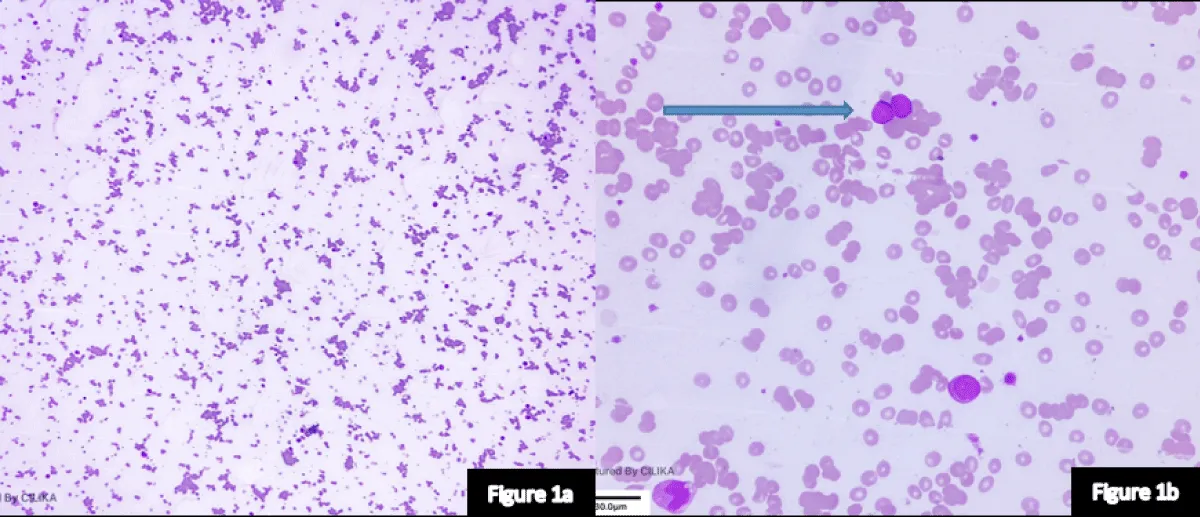
Figure 1a, b:
Cold agglutinin syndrome is a form of AIHA wherein the cold-reactive IgM antibodies bind to RBC antigens at a lower temperature, leading to RBC agglutination, hemolysis, and complement activation [1,3,4].
Although cold agglutinin disease is classically linked to infections and lymphoid neoplasms, its occurrence with AML is exceptionally rare [2-4]. The pathophysiological connection between AML and AIHA remains incompletely understood. Possible mechanisms include immune dysregulation in patients with underlying HCV infection, or the complement-mediated hemolysis may also be amplified in malignancy-related inflammatory states [1-3]. However, the association with newly diagnosed AML supports a malignancy-related immune phenomenon.
This case underscores the diagnostic value of peripheral smear review when automated haematology parameters are unreliable and illustrates a rare immune-mediated manifestation of acute myeloid leukemia [2,5-7].
This case highlights the rare coexistence of cold agglutinin-mediated haemolysis and acute myeloid leukemia in a young male patient with recently diagnosed hepatitis C virus infection. The presence of inconsistent erythrocyte indices on automated haematology analysis initially presented a diagnostic challenge, while peripheral blood smear examination revealed significant red blood cell agglutination and circulating myeloblasts.
The findings emphasize that automated haematological results should always be interpreted alongside clinical information and peripheral blood morphology, particularly when unexpected abnormalities are identified. Careful examination of the peripheral blood smear remains an important diagnostic tool, even in laboratories equipped with advanced automated analysers.
- Michel M, Crickx E, Fattizzo B, Barcellini W. Autoimmune haemolytic anaemias. Nature Reviews Disease Primers 2024;10: 82. Available from: https://doi.org/10.1038/s41572-024-00566-2
- Tariq MA, Almahmood M, Mushtaq J, Incorvati J. Cold Agglutinin-Mediated Hemolytic Anemia Preceding the Diagnosis of Acute Myeloid Leukemia: A Case Report and Literature Review. Cureus 2026; 18: e106577. Available from: https://doi.org/10.7759/cureus.106577
- Berentsen S. New insights in the pathogenesis and therapy of cold agglutinin-mediated autoimmune hemolytic anemia. Front Immunol. 2020;11:590. Available from: https://doi.org/10.3389/fimmu.2020.00590.
- Berentsen S, Barcellini W, D'Sa S, Randen U, Tvedt THA, Fattizzo B, et al. Cold agglutinin disease revisited: a multinational, observational study of 232 patients. Blood. 2020;136(4):480–488. Available from: https://doi.org/10.1182/blood.2020005674.
- Rim JH, Chang MH, Oh J, Gee HY, Kim JH, Yoo J. Effects of cold agglutinin on the accuracy of complete blood count results and optimal sample pretreatment protocols for eliminating such effects. Ann Lab Med. 2018;38(4):371–374. Available from: https://doi.org/10.3343/alm.2018.38.4.371.
- Gulati G, Uppal G, Gong J. Unreliable automated complete blood count results: causes, recognition, and resolution. Ann Lab Med. 2022;42(5):515–530. Available from: https://doi.org/10.3343/alm.2022.42.5.515.
- Arora H, Trivedi S, Jain P, Singhal U, Kaur A, Raina A. Collage of cases and brief review of the laboratory diagnosis and molecular testing in autoimmune haemolytic anaemia. J Family Med Prim Care. 2024;13(2):409–416. Available from: https://doi.org/10.4103/jfmpc.jfmpc_2131_22.